US FLIGHT CANCELLATIONS
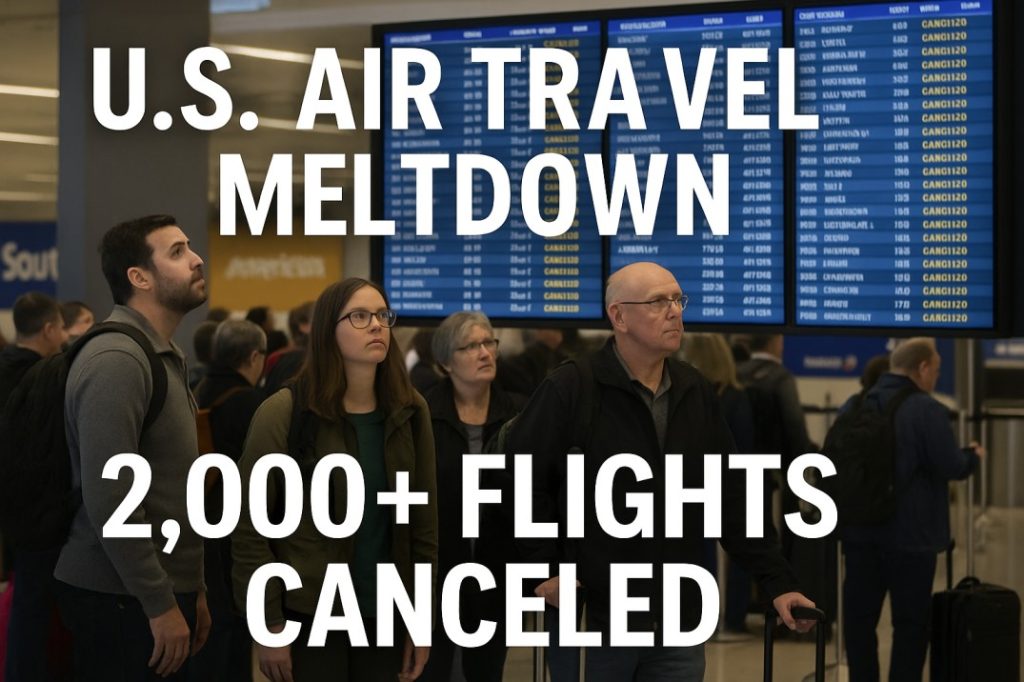
US flight cancellations is one of the most severe travel crises in years. More than 2,000 flights were abruptly canceled, according to ABC News — and thousands more delayed after the Federal Aviation Administration (FAA) restricted operations due to the ongoing government shutdown.
Travelers at Chicago O’Hare, Atlanta Hartsfield-Jackson, and Dallas-Fort Worth described scenes of panic as departure boards lit up with “CANCELED” across terminals.
“We’ve slept on benches for two nights,” said Dana Lopez, a stranded passenger from Texas. “Every announcement feels like false hope.”
The Political Tug-of-War Behind the Shutdown
This meltdown isn’t caused by weather or tech errors — it’s politics at 30,000 feet.
The U.S. government shutdown, the longest in recent years, has left essential departments unfunded, including the FAA and TSA.
Controllers are working without pay, while others call in sick, leading to major slowdowns. President Donald Trump urged them to return to work, while unions — like the National Air Traffic Controllers Association (NATCA) — warned of rising fatigue and safety risks.
“You can’t run airspace on unpaid labor,” said a NATCA spokesperson. “This isn’t politics — it’s public safety.”
How Severe Is the Disruption?
According to FlightAware, the aviation tracking portal:
Over 2,000+ flights canceled in one day
Average delay: 3–5 hours nationwide
Estimated economic loss: $350 million/day
Airline stock dips: Delta (-5%), United (-4.3%), Southwest (-3.9%)
Refund requests: Up 60% week-over-week
Business travel is collapsing, and even private charter firms report “system-wide traffic restrictions.”
The Global Domino Effect
This isn’t a localized crisis — it’s global turbulence.
Flights from London Heathrow, Frankfurt, Dubai, and Singapore are being diverted or delayed as the U.S. reduces airspace capacity.
Forbes Travel notes that international tourism to the U.S. could see a short-term dip of up to 12% if the shutdown continues through November.
Meanwhile, logistics powerhouses like FedEx and UPS — as reported by Reuters — face millions in delayed shipments and lost productivity.
Even real estate near airports is taking a hit. Commercial leases tied to tourism and logistics have already started freezing negotiations in major cities like New York and Chicago.
💬 Industry Voices: “Aviation Is Bleeding”
Aviation economist Sarah Jenkins, in an interview with CNBC, said:
“Aviation reflects political stability. When air traffic slows, trade and tourism follow — it’s a domino effect hitting every sector.”
Unions are echoing her concerns. Air traffic controllers report mental exhaustion and worry about safety lapses under pressure.
“We’re trying to keep the skies safe while worrying about rent. That’s not sustainable,” said an anonymous controller in Atlanta.
Financial Fallout: Airlines, Investors, and Insurers
The airline industry is bleeding cash. According to a Bloomberg analysis:
Airlines could lose $2–3 billion if shutdown lasts two weeks.
Travel insurance firms are processing record claim volumes.
Tourism-dependent businesses near airports have seen revenue drops of 30–40%.
Even the oil market is reacting — jet fuel demand has dipped slightly, trimming crude prices temporarily.
Passenger Survival Guide
For passengers stuck in this mess, experts from The Points Guy recommend:
Always check flight status directly on airline websites, not third-party apps.
Avoid non-refundable bookings until operations stabilize.
Use credit cards with built-in trip protection.
Contact airlines via social media DMs for faster responses — they often reply quicker there than by phone.
What the FAA and Airlines Are Doing
The FAA is now operating under emergency staffing levels. They’re prioritizing safety-critical operations, delaying low-priority flights, and diverting staff from smaller airports to major hubs.
Airlines are pressing the U.S. government for temporary relief funds, similar to the COVID-era bailout, to offset massive cancellation costs.
Some carriers are also accelerating AI-based flight management systems — long delayed due to bureaucratic hurdles — to better handle sudden crises in the future.
The Hidden Problem: Outdated Infrastructure
Experts at MIT’s International Center for Air Transportation have repeatedly warned that the FAA’s infrastructure is “outdated by decades.” Some control systems still rely on 1970s-era technology.
Aviation modernization bills often get stuck in Congress, and this shutdown has highlighted how technological stagnation meets political paralysis — a dangerous mix for a nation that moves 2.9 million passengers daily.
What Happens Next
If Congress resolves funding, the FAA expects normal operations within 72 hours — but full recovery could take weeks. Airlines will face backlogs of crew scheduling, maintenance, and passenger rebooking chaos.
Industry experts propose:
A federal aviation emergency fund insulated from political shutdowns.
AI-driven flight scheduling tools to optimize traffic during crises.
Permanent hazard pay protections for essential aviation staff.
✈️ Final Takeaway: When Politics Grounds a Nation
This isn’t just about canceled flights — it’s a lesson in vulnerability. The crisis reveals how dependent modern economies are on seamless logistics, competent governance, and updated technology.
Until aviation infrastructure is treated as a public safety priority, not a political bargaining chip, the world’s busiest skies will remain one negotiation away from another meltdown.
DoFollow External Resources Used: