
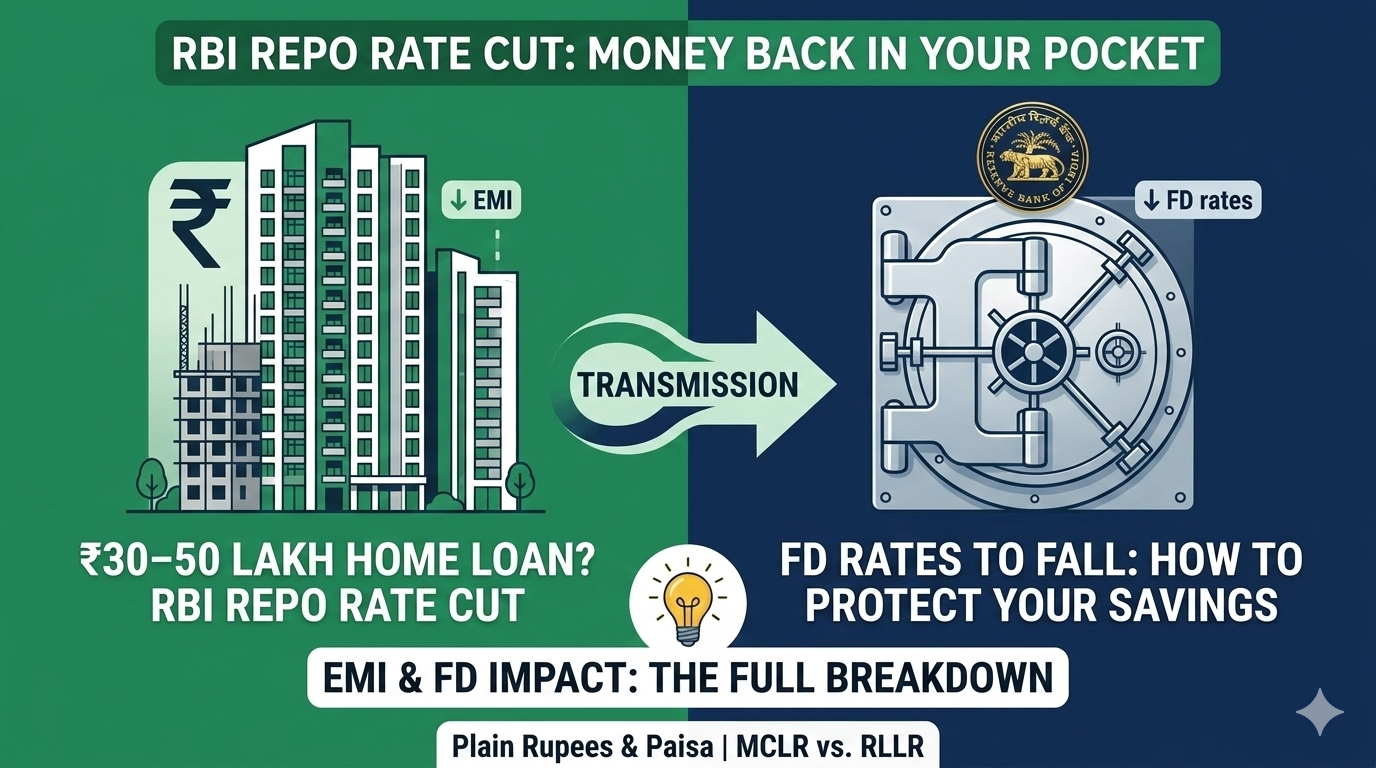
RBI Repo Rate Cut: The moment millions of home loan borrowers across India have been waiting for is finally here. The Reserve Bank of India has signalled a dovish turn in its monetary policy, and for the average Indian carrying a ₹30–50 lakh home loan, this isn’t just a news headline — it’s money back in your pocket every single month.
But here’s the thing: most people don’t actually understand how a repo rate cut flows down to their EMI. They hear “RBI cut rates by 25 basis points” and nod along without knowing whether they’ll see ₹200 or ₹2,000 less on their loan statement next month.
This article breaks it all down — in plain rupees and paisa.
What Is the Repo Rate and Why Does It Matter?
The repo rate is the interest rate at which the RBI lends money to commercial banks. Think of it as the wholesale price of money. When RBI reduces this rate, banks can borrow more cheaply — and in theory, they pass that saving on to you through lower interest rates on loans.
As of the latest Monetary Policy Committee (MPC) meeting in early 2026, the RBI has moved toward cutting rates after holding them at elevated levels since 2022–23. The inflation trajectory has moderated, with CPI inflation coming closer to the RBI’s 4% target, and GDP growth — while still strong — has shown signs of needing a nudge.
The current repo rate in 2026: Watch the RBI’s official website at rbi.org.in for the live rate — but the direction is clearly downward.
How Does a Repo Rate Cut Actually Reach Your EMI?
This is where most financial news coverage fails you. Here’s the chain:
RBI cuts repo rate → Banks’ cost of funds falls → Banks adjust their MCLR or Repo-Linked Lending Rate (RLLR) → Your loan interest rate drops → Your EMI falls
The key variable: What type of home loan do you have?
Repo-Rate Linked Loans (RLLR): Since October 2019, RBI mandated that all new floating-rate retail loans be linked to an external benchmark — most commonly the repo rate. If you took a home loan after this date, your rate is repo-linked. Rate cuts affect you quickly — usually within 1–3 months.
MCLR-Linked Loans: If your loan is older or from a bank using MCLR (Marginal Cost of Funds Based Lending Rate), the transmission is slower. MCLR resets quarterly or annually depending on the reset clause in your agreement.
Fixed Rate Loans: A repo cut does nothing for you until you refinance.
Real EMI Calculations: How Much Will You Save?
Let’s take three common loan sizes and calculate the impact of a 25 basis point (0.25%) and 50 basis point (0.50%) repo rate cut:
Assumption: 20-year remaining tenure, floating rate RLLR loan
| Loan Amount | Current Rate | After 0.25% Cut | Monthly Saving | After 0.50% Cut | Monthly Saving |
|---|---|---|---|---|---|
| ₹20 lakh | 8.75% | 8.50% | ~₹292/month | 8.25% | ~₹585/month |
| ₹35 lakh | 8.75% | 8.50% | ~₹511/month | 8.25% | ~₹1,023/month |
| ₹50 lakh | 8.75% | 8.50% | ~₹730/month | 8.25% | ~₹1,461/month |
| ₹75 lakh | 8.75% | 8.50% | ~₹1,095/month | 8.25% | ~₹2,191/month |
Over a 20-year period, a ₹50 lakh borrower saving ₹730/month from a single 25bps cut saves ₹1.75 lakh in total interest. A full 1% cut saves over ₹7 lakh.
Bank-Wise: Who Passes on Cuts the Fastest?
Not all banks are equal in transmitting RBI rate cuts. Historically:
Fastest transmission:
- State Bank of India (SBI) — being a PSU bank, politically incentivised to pass on cuts quickly
- Bank of Baroda
- Union Bank
Slower transmission:
- HDFC Bank — tends to lag by 1–2 reset cycles
- ICICI Bank — similar pattern
- Private sector banks in general
Pro tip: Check your loan sanction letter. Look for the “Reset Clause” — it tells you exactly when your rate will change after an RBI action.
What Should You Do Right Now?
If you have an existing home loan:
- Check your loan type — call your bank or check the sanction letter for RLLR or MCLR mention
- Request a rate revision if your bank hasn’t automatically reduced your rate within 3 months
- Consider balance transfer — if your current bank is slow to act, other banks may offer better rates to win your business
- Don’t extend tenure unnecessarily — when rates fall, ask your bank to reduce EMI rather than tenure if cash flow allows
If you’re planning to take a new home loan:
This is potentially the best time in 3 years to lock in a home loan. If the rate cut cycle continues, floating rate loans will benefit further. Take the loan now, and every subsequent cut becomes a bonus.
The Other Side: What Repo Rate Cuts Do to Your Savings
Good news for borrowers is bad news for savers — at least in the short term.
Fixed Deposits: Banks will start trimming FD rates within weeks of a repo cut. If you have FDs coming up for renewal, consider locking in longer-term FDs (3–5 years) at current rates before they fall further.
Debt Mutual Funds: When rates fall, bond prices rise. Short-duration and medium-duration debt funds typically deliver strong returns in a rate-cutting cycle. This is a good time to add allocation to these funds.
Liquid Funds: Returns will compress slightly but remain better than savings accounts.
The Bigger Picture: Why RBI Is Cutting Now
The RBI’s decision to pivot toward rate cuts in 2026 is driven by several converging factors:
Inflation under control: After years of elevated food and fuel prices, headline CPI has moderated closer to the 4% target. Core inflation (excluding food and fuel) has been well-behaved.
Global context: The US Federal Reserve has also begun its rate-cutting cycle, giving emerging market central banks like RBI more room to cut without risking capital outflows.
Growth support: While India’s 7%+ GDP growth is robust, manufacturing and private investment need cheaper credit to sustain the momentum.
Political cycle: Rate cuts before major state elections — let’s acknowledge this reality too.
Will There Be More Cuts in 2026?
Most economists are projecting 2–3 more rate cuts of 25 basis points each through 2026, potentially bringing the repo rate down by a total of 75–100 basis points from its peak. This would bring home loan rates to potentially sub-8% territory for quality borrowers — levels not seen since pre-COVID times.
For a ₹50 lakh home loan, a 100bps total reduction means EMI savings of approximately ₹3,000/month, or ₹7.2 lakh over the remaining loan tenure. That’s a real, meaningful impact on household finances.
Action Checklist for Today
- Find your loan sanction letter and identify RLLR/MCLR type
- Mark your rate reset date on your calendar
- Compare current home loan rates on Bankbazaar or Paisabazaar
- Move FD renewals to longer tenures before banks cut rates
- Consider adding a short-duration debt fund to your portfolio
The RBI has just put more money in your pocket. Make sure you actually receive it.
Disclaimer: EMI calculations are illustrative. Actual savings depend on your specific loan terms. Consult your bank or financial advisor for personalised advice.