Registered Valuer Organisations don’t usually make headlines. They’re the quiet institutional layer sitting between individual valuers and the MCA — the bodies that admit valuers, enforce their code of conduct, and vouch for their credibility to the broader market. But MCA’s latest amendment to the valuation rules has put RVOs squarely in the spotlight, because for the first time since the framework was created in 2017, they’re being asked to prove they have real financial substance behind them.
What the amendment actually says
On 1 June 2026, MCA notified the Companies (Registered Valuers and Valuation) Amendment Rules, 2026, published in the Official Gazette via notification G.S.R. 432(E), coming into force from the date of publication — 5 June 2026 in most reporting. The amendment substitutes Rule 12(1)(i) of the Companies (Registered Valuers and Valuation) Rules, 2017, which governs the eligibility criteria an entity must meet to be recognised as a Registered Valuer Organisation.
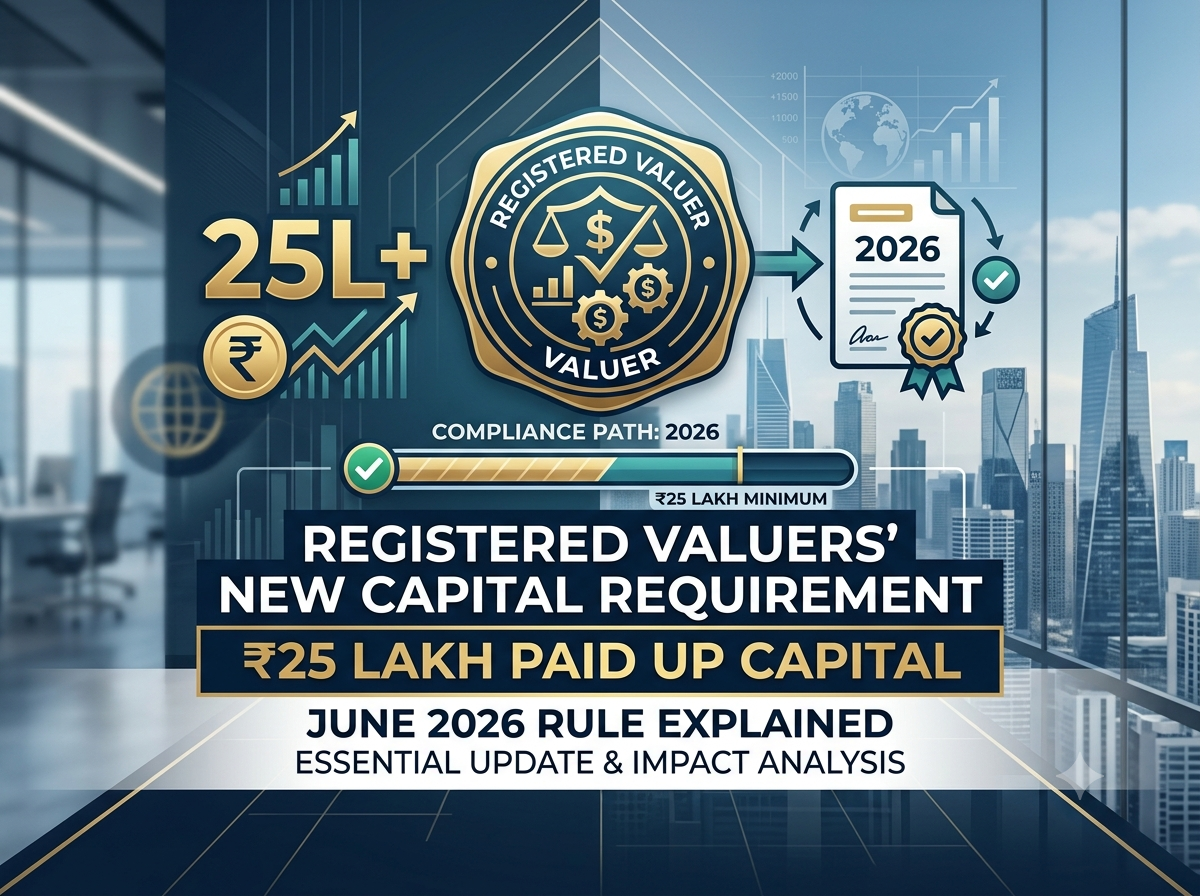
Under the revised rule, an entity seeking recognition as an RVO must satisfy four conditions together, not any one in isolation. It must be registered as a company under Section 25 of the Companies Act, 1956, or Section 8 of the Companies Act, 2013 — meaning it operates as a not-for-profit company, consistent with the regulatory character these bodies have always had. It must have the sole object of dealing with matters relating to the regulation of valuers of one or more asset classes — no mixing valuer regulation with other unrelated activities. Its bye-laws must contain the requirements specified in Annexure III of the Rules. And — this is the new piece — it must maintain a minimum paid-up share capital of ₹25 lakh.
Before this amendment, there was no minimum capital requirement for an RVO at all. An organisation could be recognised purely on the strength of its legal structure, its stated objects, and compliant bye-laws, regardless of its financial backing. The ₹25 lakh threshold changes that calculus meaningfully — it’s not a huge number for a serious institutional player, but it’s a real bar for a body that’s been running on a shoestring.
The transition window
MCA hasn’t sprung this on existing RVOs without notice. Any RVO that doesn’t currently meet the ₹25 lakh paid-up capital requirement as of the date the amendment came into force has been given until 31 March 2028 to comply. That’s roughly a two-year runway — generous by the standards of most Indian regulatory transitions, and a clear signal that MCA wants existing, functioning RVOs to have a real opportunity to raise capital or restructure their finances rather than face immediate derecognition.
Why this is happening now
This amendment doesn’t exist in isolation. It lands against the backdrop of the broader Corporate Laws (Amendment) Bill, 2026, which is separately proposing to designate the Insolvency and Bankruptcy Board of India (IBBI) as the overarching Valuation Authority — the body that would grant certificates of registration and recognition to valuers, recommend valuation standards to the government, and generally oversee the profession end to end. Read together, the direction is unmistakable: India’s valuation ecosystem, which has grown substantially in importance since IBC-driven insolvency resolutions and routine statutory valuations under the Companies Act became commonplace, is being pushed toward greater institutional seriousness. A capital floor for RVOs is a fairly standard regulatory move once you decide an intermediary body needs enough financial substance to actually function as a credible, self-sustaining regulator of its members — able to run examinations, maintain disciplinary processes, and survive the occasional legal challenge without folding.
There’s also a governance logic here that mirrors what’s happening in adjacent spaces — NFRA is being restructured with a dedicated fund and corporate status around the same time, and SEBI’s own recognised bodies operate under similar capital-adequacy thinking. RVOs being asked to demonstrate they have skin in the game, financially, fits that broader pattern of MCA tightening the institutional layer of professional regulation across the board in 2026.
What this means if you run, or are affiliated with, an RVO
If you’re involved in running an existing Registered Valuer Organisation, the first thing to do is check your current paid-up capital against the ₹25 lakh figure honestly, not optimistically. If you’re short, you have until 31 March 2028, but two years is not a long runway if raising additional capital as a Section 8 company involves bringing in new members’ contributions, restructuring your funding model, or seeking philanthropic or institutional support — all of which take time to negotiate and execute properly. Starting that conversation with your governing council or board now, rather than in 2027, is the sensible move.
If you’re a valuer registered under an RVO that might struggle to meet this requirement, it’s worth having an honest conversation with your organisation’s leadership about their capital-raising plan. An RVO that loses recognition doesn’t just disappear quietly — its registered valuers would need to transition to another recognised RVO, which is disruptive to your own practice and credentials at exactly the wrong time if it happens in a rush near the 2028 deadline rather than in an orderly, planned way.
If you’re contemplating setting up a new RVO — perhaps for a niche or emerging asset class that doesn’t yet have dedicated valuer regulation — factor the ₹25 lakh capital requirement into your initial planning from day one. This is no longer a “figure it out later” line item; it’s a threshold condition for recognition, alongside your Section 8 registration and bye-laws.
What this means for companies that rely on valuers
For most companies engaging registered valuers for statutory purposes — share valuations, fair value assessments under Ind AS, IBC-related valuations, or M&A due diligence — this change is largely invisible in the short term. Your valuer’s individual registration and competence aren’t directly affected by their RVO’s capital position, at least not before 2028. But it’s worth keeping half an eye on which RVO your regular valuers are affiliated with, particularly if you rely on a smaller or newer organisation, simply to avoid disruption down the line if that RVO struggles with the transition.
The bigger picture
This is a small rule change in terms of the raw text — one substituted sub-clause — but it reflects a real shift in how MCA is thinking about the institutional scaffolding beneath India’s valuation profession. Combined with the proposed elevation of IBBI as the overarching Valuation Authority, the message to RVOs is clear: recognition now comes with a financial substance requirement, and the two-year clock is already running.
This article reflects the Companies (Registered Valuers and Valuation) Amendment Rules, 2026 as notified. RVOs and valuers should consult the official gazette notification and their professional advisors for guidance specific to their organisation’s compliance timeline.