The pitch behind every robo-advisor is the same: answer a risk questionnaire, and an algorithm builds and rebalances a diversified portfolio for you, at a fraction of what a human wealth manager would charge. In India, that promise has attracted a genuinely broad range of platforms — from goal-based investment apps to full-service digital wealth managers — and the differences between them matter a lot more than the marketing pages let on. Here’s how to actually evaluate one.
What a robo-advisor is actually doing under the hood
Strip away the interface, and most robo-advisors in India are running a fairly standard process: a risk-profiling questionnaire feeds into an asset allocation model (typically a mix of equity, debt, and sometimes gold or international funds), which then gets implemented through a curated basket of mutual funds or ETFs. Periodic rebalancing brings the portfolio back to target allocation as markets move. The “AI” or “algorithm” branding varies enormously in how much genuine machine learning is involved versus a rules-based allocation engine — and for a retail investor, that distinction matters less than whether the underlying process is sound and the costs are reasonable.
The main categories of platforms in India
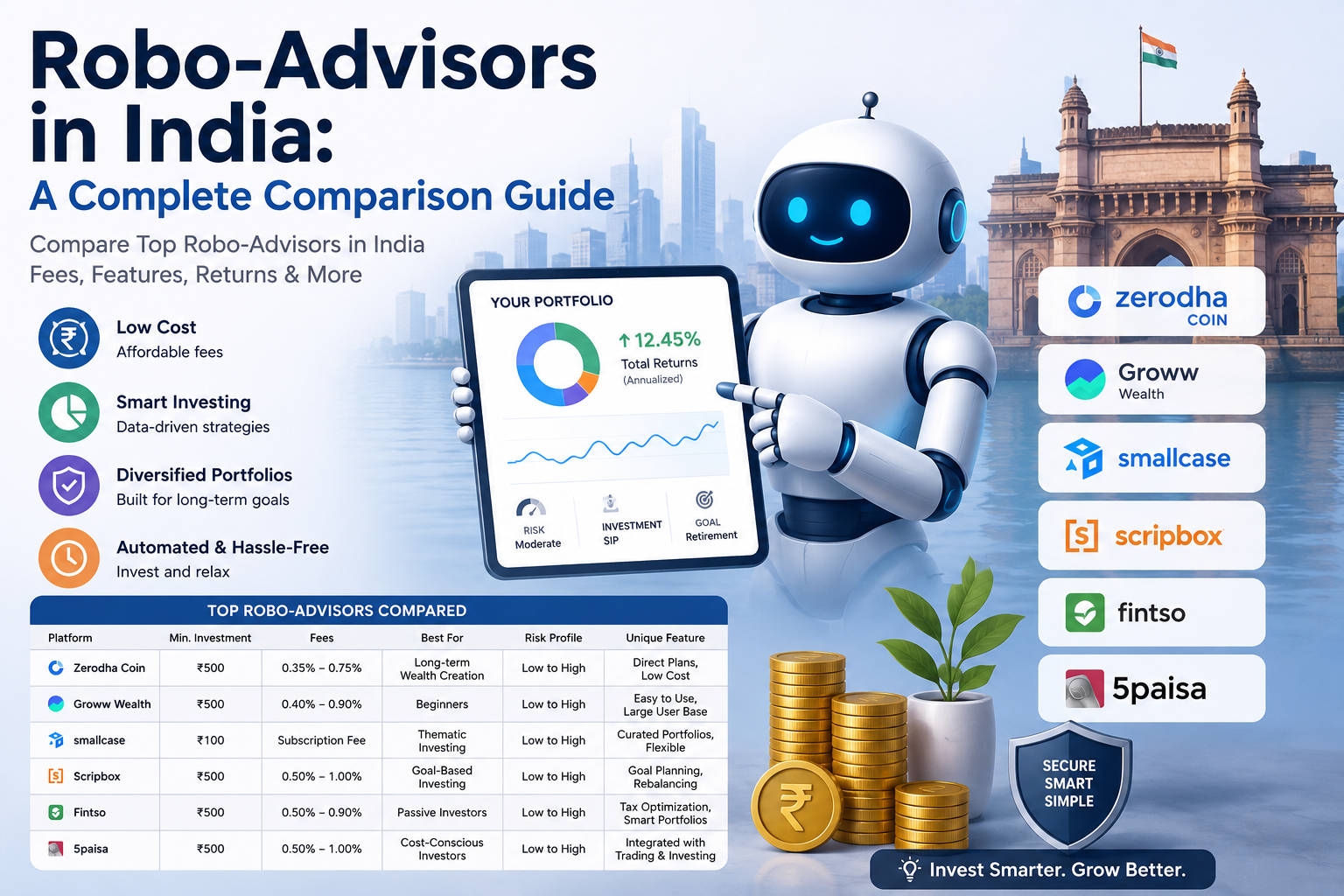
Direct mutual fund platforms with advisory layers. Platforms like Kuvera and ET Money built their base offering around commission-free direct mutual funds, then layered goal-based planning and portfolio recommendations on top. The appeal here is cost — you’re not paying platform fees on top of fund expense ratios, since direct plans already strip out distributor commissions.
Goal-based investment apps. Scripbox is a good example of a platform built explicitly around financial goals (retirement, a child’s education, a house down payment) rather than raw fund selection, with the algorithm choosing and rebalancing funds to match a target timeline and risk level.
Broker-integrated robo tools. Groww and Paytm Money, primarily known as brokerage and mutual fund distribution platforms, have added robo-advisory-style features — model portfolios, goal calculators, recommended fund baskets — as an extension of their broader product, rather than as a standalone specialized offering.
Full-service digital wealth managers. Platforms targeting higher-ticket investors combine robo-driven asset allocation with access to human advisors, alternative investments, and more sophisticated tax-aware strategies — closer to a hybrid model than a pure robo-advisor.
What actually differs between them, and what to check
Fee structure. Some platforms charge a flat advisory fee, some earn through fund distribution commissions on regular (non-direct) plans, and some are genuinely free, monetizing through other products. A platform earning commission on regular plans has a structural incentive that isn’t fully aligned with your interest in minimizing costs — always check whether the underlying funds recommended are direct or regular plans, since the expense ratio difference compounds significantly over long horizons.
Depth of the risk-profiling process. A five-question quiz that sorts you into “conservative, moderate, aggressive” is a much cruder tool than a process that accounts for your investment horizon, existing assets, liquidity needs, and goal-specific risk tolerance (your retirement risk tolerance and your two-year house-downpayment risk tolerance should not be treated identically, but many simplistic robo tools do exactly that).
Rebalancing logic and frequency. Ask, or check the fine print for, how often the platform actually rebalances your portfolio and what triggers it — calendar-based (quarterly, annually) versus threshold-based (rebalance when an asset class drifts more than X% from target). Threshold-based rebalancing is generally more disciplined and tax-efficient, since it avoids unnecessary churn.
Tax awareness. A genuinely sophisticated robo-advisor accounts for capital gains tax implications when rebalancing or switching funds — harvesting losses where beneficial, being mindful of long-term versus short-term capital gains thresholds — rather than mechanically rebalancing without regard for the tax cost triggered.
Transparency of the underlying model. Some platforms are reasonably transparent about their allocation methodology; others treat it as a black box. You don’t need to see the code, but you should be able to understand, in plain terms, why the platform is recommending a specific allocation for your goals.
Where robo-advisors genuinely add value
For a first-time investor without the time, interest, or confidence to build a diversified portfolio manually, a decent robo-advisor solves a real problem: it removes the paralysis of fund selection, enforces discipline through automated rebalancing (which most self-directed investors fail to do consistently), and — critically — keeps costs meaningfully lower than a traditional distributor-driven advisory relationship, where trail commissions on regular mutual fund plans can quietly cost an investor a substantial amount over a couple of decades.
Where they fall short
Robo-advisors are built for standard situations — someone saving toward conventional goals through mutual funds. They’re generally not well-suited to complex financial situations: business owners with irregular cash flows, investors with significant existing equity concentration (like ESOPs) that needs to be managed alongside new investments, or anyone needing estate planning, tax structuring across multiple income sources, or nuanced insurance and liability planning. For these situations, the algorithm’s simplicity becomes a limitation rather than a feature, and a human advisor — ideally a fee-only one without commission incentives — is worth the additional cost.
There’s also a behavioral risk worth naming honestly: automation can create a false sense of “set it and forget it” security. A robo-advisor rebalancing your portfolio doesn’t mean you can skip periodically reviewing whether your goals, income, and risk tolerance have changed. The algorithm optimizes within the parameters you gave it at onboarding — it doesn’t know your job situation changed or that your investment horizon just got five years shorter unless you tell it.
How to choose, practically
- Check whether recommended funds are direct plans. If not, ask why, and calculate what the regular-plan commission is costing you annually.
- Look at the actual asset allocation logic, not just the marketing language — does it adjust meaningfully based on your specific goal and horizon, or does everyone in the “moderate risk” bucket get the same portfolio?
- Understand the rebalancing and tax logic, since this is where a genuinely well-built platform distinguishes itself from a glorified fund-picker.
- Match the platform to your complexity level. Simple goals, simple income situation — a robo-advisor is likely sufficient. Complex financial life — treat robo-advisory as one input, not the whole plan.
The takeaway
Robo-advisors in India have matured well past the “algorithm picks your mutual funds” pitch of their early years, and for straightforward, goal-based investing, they now offer a genuinely useful combination of low cost, behavioral discipline, and simplicity that beats what most first-time investors would build on their own. But “algorithm-managed” isn’t automatically synonymous with “optimal” — the fee structure, rebalancing logic, and tax-awareness baked into the platform matter far more to your actual long-term returns than whichever one has the slickest onboarding flow.