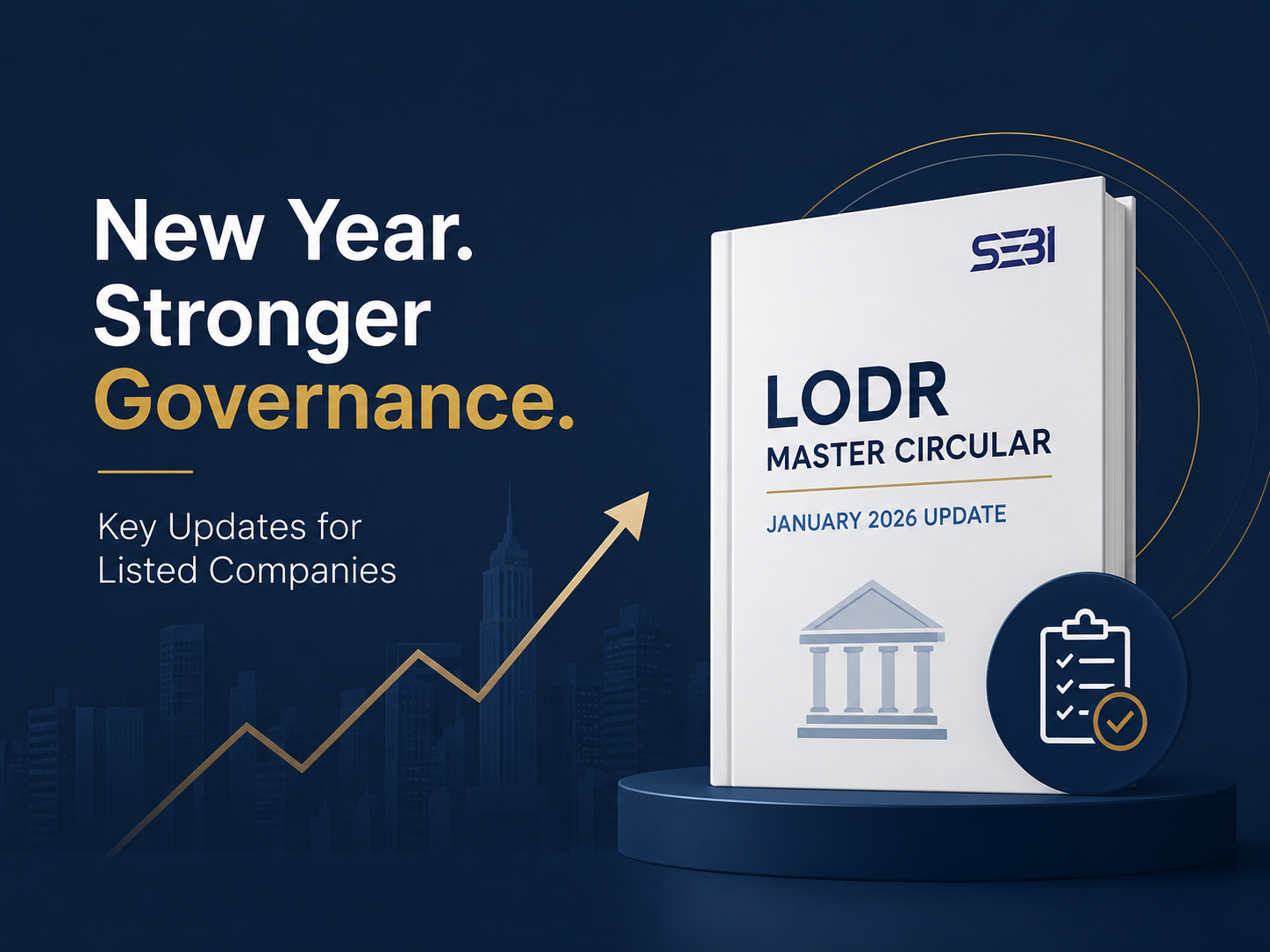
On January 30, 2026, SEBI issued its updated Master Circular for compliance with the Listing Obligations and Disclosure Requirements Regulations, 2015 — consolidating everything operative up to December 30, 2025, and rescinding more than fifty earlier circulars in the process. If you’re a company secretary at a listed company, this is the document you now keep permanently open in a browser tab, because it’s the single authoritative reference for practically everything SEBI expects of listed entities: disclosures, governance reporting, related-party transactions, investor services, and increasingly, ESG reporting.
The original version of this Master Circular dates back to July 2023, and SEBI has updated it periodically since — most recently before this in November 2024. The January 2026 version is the biggest consolidation yet, and it’s worth walking through what actually changes for a listed company’s day-to-day compliance calendar, rather than just noting that “SEBI issued an update,” which tells you almost nothing useful.
Integrated filing becomes the load-bearing structure
The single biggest structural shift baked into this Master Circular isn’t new as of January 2026 — it started rolling out roughly a year earlier — but it’s now fully consolidated as the backbone of the disclosure regime. SEBI has organised periodic disclosures into two integrated filing categories: governance and financial.
Governance-related filings — corporate governance reports, investor grievance updates, and similar recurring disclosures — need to be filed within 30 days of each quarter’s end. Financial filings, which bundle together quarterly financial results, related-party transaction disclosures, and outstanding loan-default reporting, get a 45-day window. Year-end financial disclosures get a slightly longer 60-day runway. The practical effect is that a company secretary is no longer tracking a dozen separate filing deadlines scattered across the quarter for what are, functionally, related pieces of information — they’re tracking two integrated submissions per quarter, each with a clear, fixed timeline.
This matters more than it sounds like it should, because a huge share of routine LODR non-compliance historically wasn’t about companies hiding something — it was about compliance calendars simply losing track of an obscure filing with its own idiosyncratic deadline. Integrated filing doesn’t reduce what companies have to disclose; it reduces the number of places they have to remember to disclose it.
Related-party transaction disclosures get a standard format
RPTs have their own sub-thread running through the Master Circular, and it’s been evolving steadily. SEBI’s November 2024 circular set out broad requirements for what information needs to go before the Audit Committee and shareholders when approving an RPT, but stopped short of prescribing an actual format. That gap got closed through an Industry Standards mechanism — a joint SEBI–industry forum process that produced “Industry Standards on Minimum Information” for RPT approvals, first made applicable from April 2025, then deferred to July 2025 after stakeholder pushback, and then revised again into a further set of Revised RPT Standards effective September 1, 2025, which superseded the earlier version.
What this means in practice: listed companies preparing an RPT for Audit Committee or shareholder approval now need to follow a specific, standardised template for what information gets placed before the approving body — valuation basis, materiality justification, arm’s-length reasoning, and so on — rather than each company deciding for itself what counts as adequate disclosure. Half-yearly RPT disclosures to stock exchanges also now need to include ratification details for any RPTs, closing a gap where companies previously disclosed the existence of a transaction without necessarily showing that it had gone through proper ratification.
Investor services move further toward compulsory dematerialisation
The Master Circular also tightens the mechanics around physical share certificates in a way that continues a multi-year SEBI push to eliminate physical holding almost entirely. Investor service requests — subdivision of shares, renewal of expired certificates, exchange of certificates, and similar transactions — now mandatorily require the shares to be credited in dematerialised form rather than reissued as physical certificates. SEBI has also built in a special physical-to-demat conversion window running from February 2026 through 2027, effectively giving investors who still hold physical shares in listed companies a defined runway to convert before physical certificates become close to unusable for these purposes.
For a company’s registrar and share transfer agent, this means investor service requests that used to result in a fresh physical certificate now need to be redirected into the demat process by default — a workflow change that sounds administrative but touches a meaningful volume of routine investor correspondence, especially for older shareholders who’ve held physical certificates for decades and haven’t had a reason to dematerialise until a service request forced the issue.
System-driven monitoring and automated enforcement
A theme that runs quietly through the entire consolidated circular is a shift toward system-driven monitoring of compliance timelines rather than manual tracking by exchanges. Where previously a stock exchange might flag a late filing after the fact through manual review, the framework increasingly relies on automated systems to track filing deadlines and trigger consequences — penalties, escalation notices, or surveillance flags — without requiring a human at the exchange to notice the lapse first. For listed companies, the practical implication is that the margin for a filing to quietly slip a day or two past deadline without consequence is narrowing. A missed integrated filing deadline is more likely to generate an automatic penalty notice than it was even two years ago.
BRSR pressure builds for the largest companies
Business Responsibility and Sustainability Reporting — BRSR, and specifically the BRSR Core subset of more rigorous, assurance-backed ESG metrics — continues to be phased in for progressively larger cohorts of listed companies, and the top 500 listed entities by market capitalisation remain the group facing the most immediate pressure to have functioning ESG data-collection systems in place, rather than treating sustainability reporting as an annual scramble. The Master Circular consolidates the applicable BRSR reporting requirements into the same framework as financial and governance disclosures, which is itself a signal: SEBI is treating sustainability data with the same disclosure rigor it applies to financial results, not as a softer, aspirational add-on.
What company secretaries should actually do with this
The honest advice here is unglamorous but important: don’t treat this as a document to skim once and file away. Map your company’s existing compliance calendar against the consolidated integrated-filing categories and confirm nothing is still being tracked under an old, superseded circular reference. Check that your RPT approval documentation follows the Revised RPT Standards format rather than whatever ad hoc template your company built before September 2025. If your registrar is still processing subdivision or renewal requests by issuing fresh physical certificates, that workflow needs to change before the special conversion window closes sometime in 2027. And if you’re at one of the larger listed entities facing BRSR Core obligations, the time to build a genuine ESG data pipeline was probably a year ago — but the next best time is now, before the assurance requirements catch a reporting gap you didn’t know you had.
None of this is about SEBI creating brand-new obligations out of nowhere. Almost everything in the January 2026 Master Circular existed in some form before — scattered across circulars, industry standards, and clarifications issued over the preceding eighteen months. What’s changed is that it’s now genuinely possible to check one document and know, with reasonable confidence, what’s actually required of you. That’s a small thing to be grateful for in Indian securities compliance, but it’s not a nothing thing either.