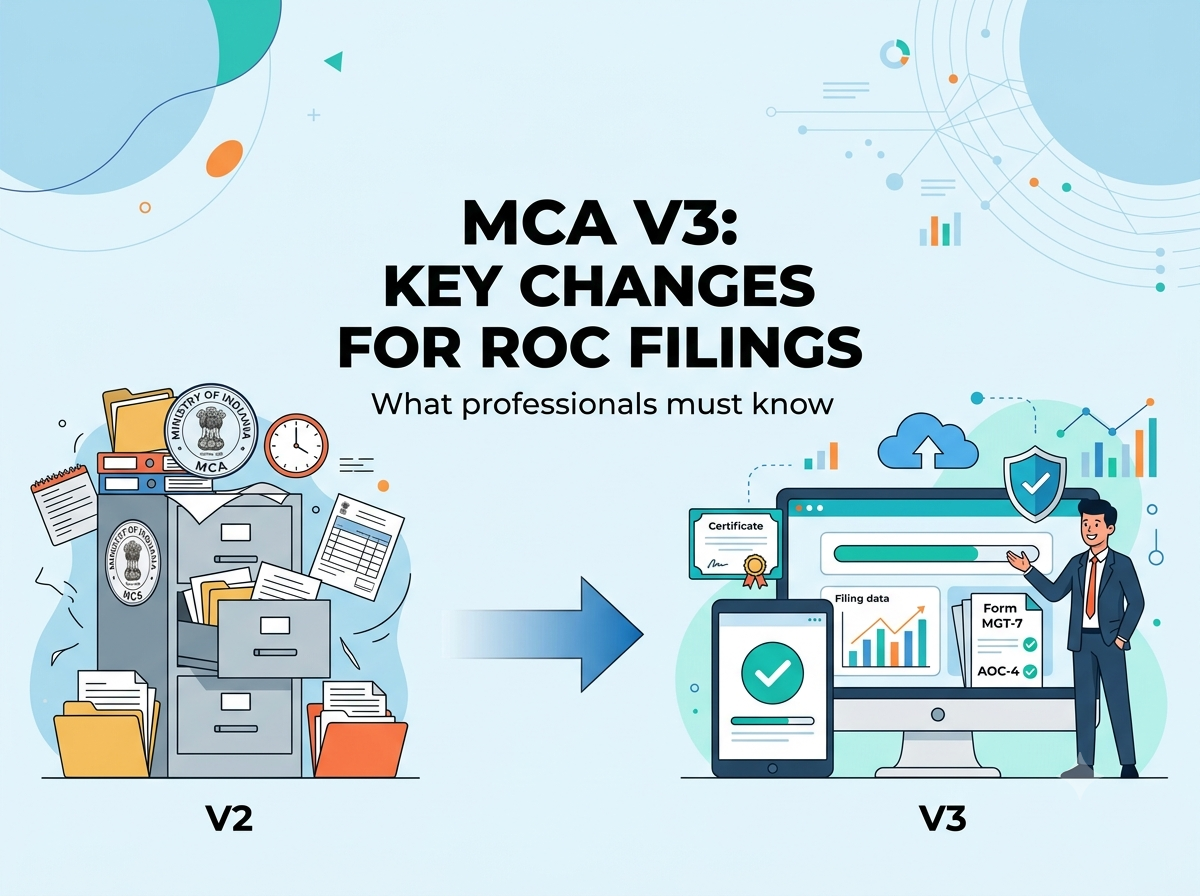
If you’ve filed anything with the Registrar of Companies in the last year, you’ve already lived through some version of this transition. But if your company only files annually — an AOC-4 here, an MGT-7 there — the shift from the old MCA21 V2 portal to V3 might still feel like unfamiliar territory. And as of mid-2026, there’s no more choice in the matter: V2 has been permanently switched off, with the final decommissioning completed by 30 June 2026. Every single company filing in India now happens on V3. Here’s what that actually means in practice, beyond the obvious “new interface” headline.
This was a four-year rollout, not a sudden switch
It’s worth understanding the timeline, because a lot of confusion stems from companies assuming this was one big-bang cutover. It wasn’t. The migration began back in 2022 and moved in phases: incorporation forms like SPICe+, AGILE-PRO-S, and RUN moved first, launching in late 2023. Annual filing forms — AOC-4, MGT-7, DIR-3 KYC — along with charge-related forms followed through 2024. Event-based forms like INC-22 and DIR-12, plus LLP forms and the inspection and search module, came in Phase 3. The last big batch — 38 company e-forms including the annual filing heavyweights — went fully live on V3 on 14 July 2025, with V2 filing for those forms disabled shortly after. The final shutdown of V2 in its entirety, covering charge creation forms like CHG-1 and CHG-9 and Director KYC, came on 30 June 2026.
If your company hasn’t filed anything since before mid-2025, this entire transition might be new to you in one sitting — which is exactly the situation where mistakes happen, so it’s worth walking through the practical differences carefully.
What’s genuinely different, not just cosmetically
The most visible change is that V3 does away with the old download-fill-upload PDF workflow entirely. V2 always felt a bit like a relic of an earlier internet era — you’d download a PDF form, fill it out using Adobe’s form-filling tools, save it, and upload it as a file. V3 is a proper web-based system: you fill out forms directly in the browser, much like any modern online application process.
That shift enables real-time validation, which is the change compliance professionals have actually welcomed. V3 catches basic errors — mismatched CIN details, missing mandatory fields, inconsistent director information — before you submit, rather than after ROC scrutiny flags them days or weeks later. It also means a meaningfully higher proportion of forms now go through Straight Through Processing (STP), getting approved automatically without manual ROC intervention, provided there’s nothing unusual flagged in the filing.
Processing timelines differ by form type. STP forms — the ones that don’t need manual ROC review — typically clear in two to five working days. Forms that do require scrutiny, such as CHG-1 for charge registration or INC-22 for a change in registered office, can still take fifteen to thirty working days, so don’t assume every filing on V3 is instant just because the portal is faster.
Document handling has also improved — higher file size limits and better attachment handling than the old system, which used to choke on anything beyond fairly modest PDF sizes. And the portal now does more ROC data pre-fill, pulling existing company and director information into forms automatically rather than making you retype details that MCA already has on file.
One thing that hasn’t changed: the fee structure. MCA has been explicit that the V3 migration is a platform and process change, not a fee revision. Whatever you were paying for a given form based on authorised share capital under V2, you’ll pay the same under V3.
The friction points, honestly
The rollout wasn’t smooth, and it’s worth being upfront about that rather than pretending V3 arrived polished. DSC (digital signature certificate) validation had real stability problems in the initial rollout phases back in late 2024, and payment gateway issues cropped up again through late 2025, with users reporting failed transactions and stuck SRNs. Both have largely settled down by mid-2026, but if you had a bad experience with V3 a year or so ago and have been avoiding it since, it’s genuinely a different, more stable system now.
One payment gap that persists: UPI is still not supported on the V3 gateway as of mid-2026. You’re limited to net banking, debit or credit card, and the MCA’s own pre-filled wallet system — which, if you file multiple forms across the year, is worth setting up and loading in advance simply for convenience.
There was also a real headache around the transition itself for some companies: SRNs that were filed on V2 right before the cutover and ended up marked “Not To Be Registered” (NTBR) due to pending security holder or subsidiary data uploads that didn’t carry over cleanly. If you have an SRN in that state, most of these have now been resolved, but if yours is still showing as pending, the fix is a direct call to the MCA helpdesk with your SRN details rather than re-filing from scratch.
What to actually do before your next filing
Before you sit down to file anything on V3, confirm three things: that your DSC is current and properly registered against your role in the filing (director, CS, or authorised signatory), that your emsigner software is updated to the latest version compatible with V3 (an outdated emsigner is one of the most common avoidable filing failures), and that you’re checking the MCA portal to confirm the specific form you need is indeed live on V3 rather than assuming — though at this point, virtually everything is.
If you’re managing filings across a compliance calendar for multiple entities, it’s worth building a small internal note reminding your team that fee structures are unchanged, STP forms move fast, scrutiny-based forms still take weeks, and UPI isn’t an option yet. These are the small operational details that trip people up, not the headline “we moved to a new portal” fact everyone already knows.
The bottom line
V3 is, genuinely, a better system than V2 — faster in most cases, more forgiving with real-time validation, and better at reducing avoidable rejections. The transition period is over; there’s no fallback to V2 anymore, so the sensible move for any company or compliance professional is to stop thinking of this as “the new portal” and start treating it simply as how ROC filing works now.
This article reflects the MCA V3 migration status as of mid-2026. Companies should verify current form availability, fees, and processing timelines directly on the MCA portal before filing.